Washing Machine Hose Bursts: AZ Prevention Guide
· By Apache Junction Water Damage
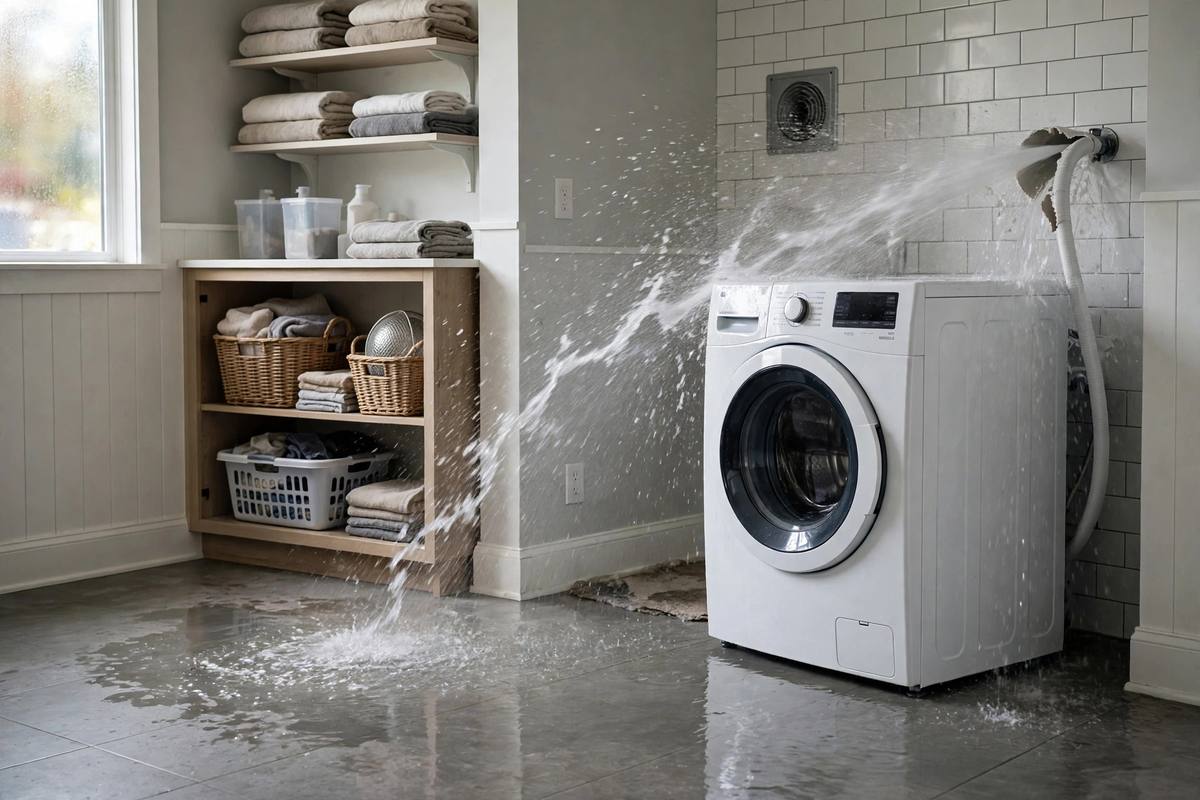
Your washing machine's supply hoses sit under full household water pressure around the clock, whether the machine is running or not. When one bursts — usually at 2 a.m., usually while nobody is watching — it can pump out hundreds of gallons per hour, flooding the laundry room and everything downhill of it. In Arizona, garage and exterior-wall laundry setups expose hoses to extreme heat that accelerates rubber deterioration.
This is one of the most destructive yet most preventable floods in Valley homes.
Why Washer Hoses Fail
Age and heat
Standard rubber hoses last about five years under ideal conditions. In a 120-degree garage, that lifespan shrinks. The rubber hardens, cracks, and eventually splits along its length.
Constant pressure
Unlike a garden hose you turn off, washer hoses never get a break. Every pressure spike in the municipal system hammers the weakest point.
Kinking and abrasion
Hoses shoved too close to the wall kink behind the machine, weakening the rubber at the bend. Vibration during spin cycles rubs hoses against the wall or machine casing.
Poor connections
Over-tightened or cross-threaded fittings crack; under-tightened ones weep. Either way, the connection is a common failure point.
Prevention: Cheap Insurance
Replace rubber hoses with braided stainless steel supply lines — they resist bursting, kinking, and heat far better, and cost little. Do this every five years regardless of appearance, and date the new hoses with a tag or marker so you remember. Leave at least four inches between the machine and the wall to prevent kinking, and check connections yearly for corrosion or dampness. The best upgrade of all: install single-lever shutoff valves (or an automatic shutoff with leak sensors) and make it a habit to close them when the washer is not in use — especially before vacations. A washer that runs only while you are home to hear a problem is a far smaller risk.
After a Burst: Act in Minutes
Kill the water at the washer valves or the main shutoff, then unplug the machine if water is near the outlet (never stand in water to do it). Wet-vac or mop up standing water fast — laundry rooms often sit on slab with adjacent carpeted rooms wicking moisture outward. Pull the machine out and check behind and beneath it; water hides there and feeds mold. If drywall, baseboards, or flooring in adjoining rooms got wet, professional help pays for itself: emergency water extraction removes what mops cannot, and structural drying services verify walls and subfloors are truly dry with moisture meters, not guesswork.
Learn more from professional water damage help in Apache Junction on appliance-leak recovery.
Laundry Room Flood Defenses Beyond Hoses
Upgraded hoses are the first line of defense, but a truly flood-resistant laundry room layers several more. A washing machine drain pan — a shallow tray the washer sits in, plumbed to a floor drain or the exterior — catches leaks from hoses, pumps, and tub seals before they reach the floor. If your laundry room has no floor drain, even an unplumbed pan buys critical time by containing the first gallons.
Water alarms are the cheapest high-value upgrade: battery-powered sensors placed behind the washer and under nearby plumbing shriek when they get wet, alerting you while the leak is still small. For maximum protection, automatic shutoff systems pair leak sensors with motorized valves on the supply lines, closing the water the moment sensors detect moisture — ideal for households that run laundry while away. And whenever you travel, shut the washer valves off entirely. No pressure means no burst, no matter how old the hoses are.
Laundry room flooding? Shut the water off and call (408) 357-2008. We connect you with local providers for fast extraction across Apache Junction and Phoenix.